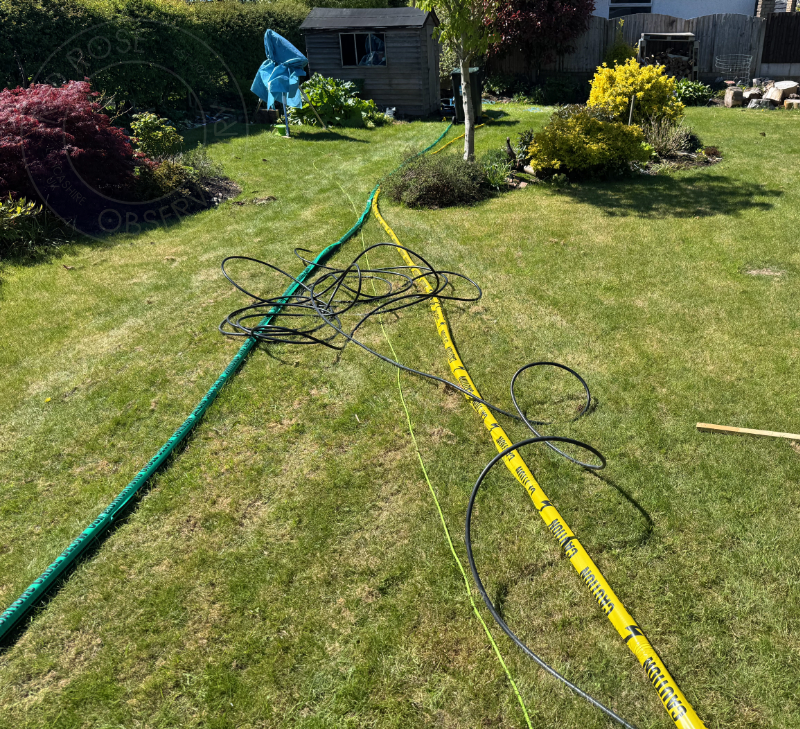
Before I start on the build of the observatory, one of the jobs that I've been needing to do is run cabling from the house to where the observatory will be. I wanted to do this during Spring so that it gave the lawn a full season of growth to recover from being cut up. Also, it was a much more pleasant job doing it on a nice sunny day rather than in the depths of winter.
Max Power and the data superhighway
My aim was to bury two ducts running from the house. The first containing a 6mm2 SWA (armoured) power cable (which gives more than sufficient capacity for the small amount of electrical load that will be in the observatory). For anyone considering doing similar, it is important to accurately calculate the rating and size of cable that will be required, as this will vary based on load, length, burial, voltage drop... etc. Online calculators are available to work this out, but if in any doubt, contact an electrician.
The second duct would house two SWA CAT6 ethernet cables. Only one cable would give plenty of bandwidth for my needs, but as CAT6 cable has quite small and theoretically delicate cores, I thought it would be worth running a second cable to give a bit of redundancy in case of any future cable fault. Provision of a robust data connection should mean that I am able to connect to the ASIAIR that I use for my imaging sessions without any worries about intermittent wifi and loss of signal.
With the cables being armoured, I could have just buried them directly in the ground, as the steel armour should give adequate protection. However, using ducting means that by running a draw rope in the cable as well, I can always pull through additional or replacement cables at a later date. For the cost of around £70 worth of ducting, I thought this was a sensible bit of future proofing that would prevent me having to dig the garden up again in future.
Courtesy of ebay, I also purchased some cable identification tape to cover the ducting. This would ensure that if it was accidentally unearthed at a future point, it would be easily apparent as to exactly what it was. These use the standard colours of yellow for power and green for "communications".
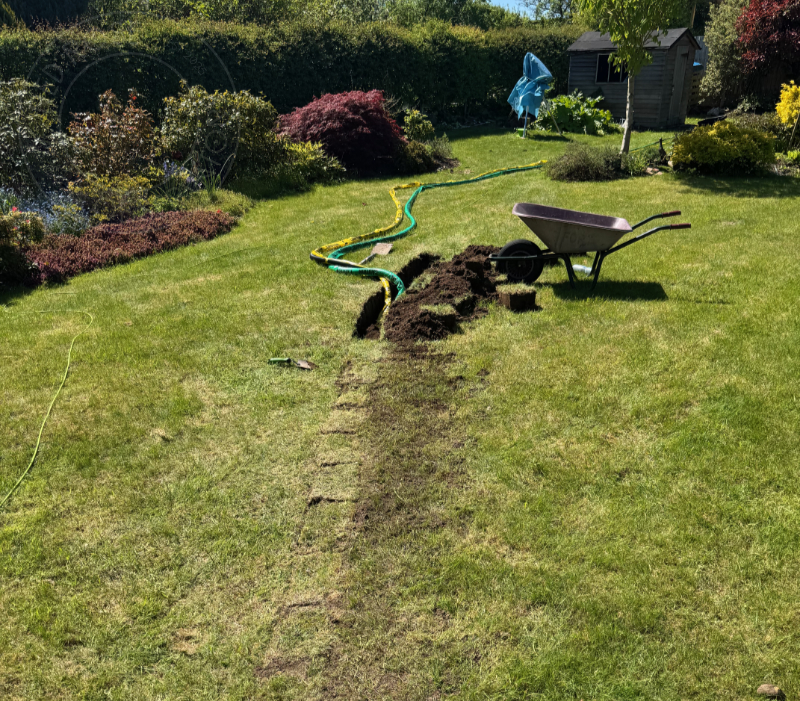
With 15m worth of trench to dig from one end of the garden to the other, it took me three half days of effort to get both ducts buried. And boy did I ache afterwards...
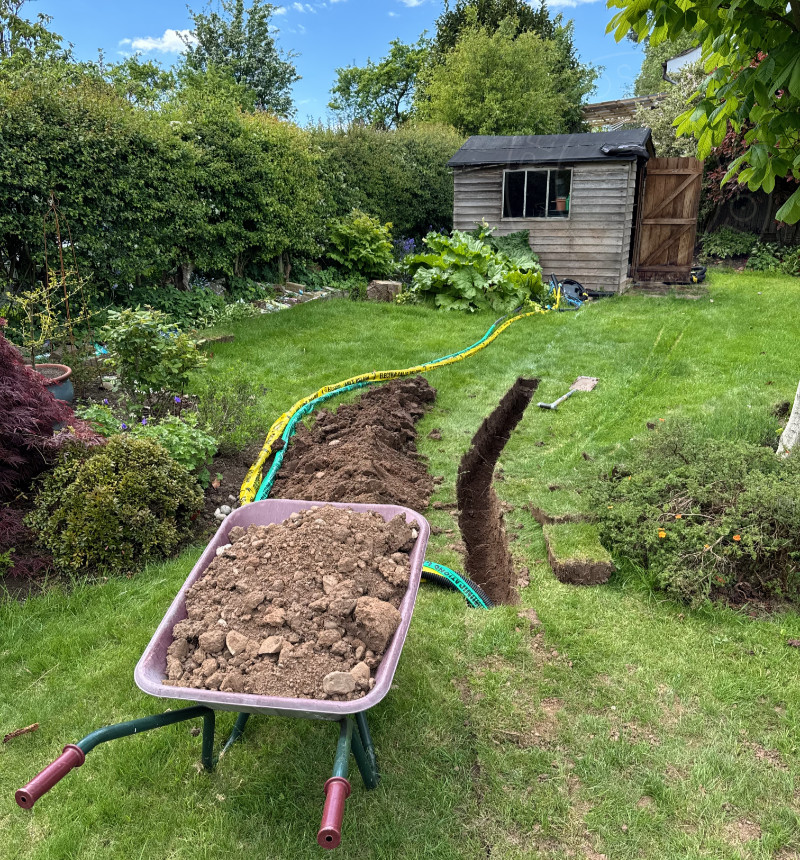
For now, neither the power cable or the ethernet cables are connected either at the house end or the observatory site end. As I use my telescope currently in the area where the observatory will be, I have been tempted to temporarily connect the ethernet so that I can use it during my current imaging sessions. But, the wifi just about works ok at the minute, so it's very much a balance between the effort to temporarily terminate and connect the CAT6 cables, versus the marginal benefit that this would give (plus the amount of free time I'd have to find).
The power cable will obviously need to be connected up in a safe and compliant manner, so I will have to get an electrician in for that. And I'm not paying for that once for a temporary feed and then again for the final observatory feed! Until the observatory is finished, an extension lead from the house is more than enough to power the telescope overnight.
Now I just patiently wait for the lawn to steadily repair itself and get rid of the evidence. It's already part way there!